

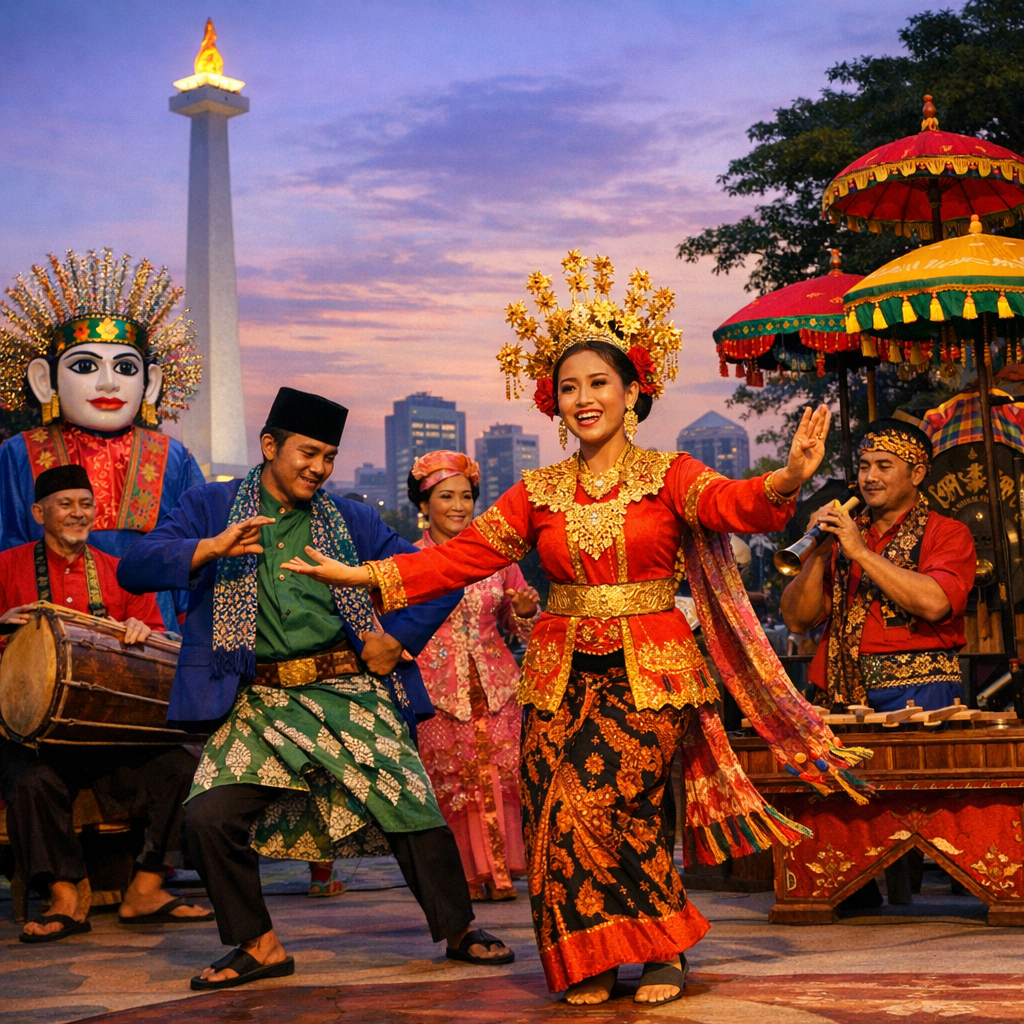
Jakarta, Indonesia’s bustling capital, is a melting pot of cultures, with the Betawi people at its heart. Their traditional music and dance forms offer a captivating glimpse into the city’s diverse heritage.
Tanjidor: The Betawi Brass Ensemble
Tanjidor is a traditional Betawi brass-band music that blends European parade and ballroom repertoire with local Indonesian taste. It is typically performed by community ensembles at weddings, neighborhood festivities, lion/ondel-ondel street parades, and Chinese-Betawi celebrations. The ensemble sound is bright and reedy, led by clarinet, trumpets/cornets, and trombones, supported by tenorhorn/baritone and tuba, with a driving battery of bass drum, side drum, and cymbals. Its repertoire includes marches, polkas, schottisches, and waltzes, alongside locally adapted melodies and Betawi favorites, all played with distinctive phrasing, ornamentation, and a convivial, outdoor timbre.
Gambang Kromong: A Cultural Fusion
Gambang Kromong is a traditional Betawi orchestra that blends Chinese and Betawi cultural elements. The ensemble uses instruments such as the gambang, kromong, tehyan, kongahyan, and sukong, along with other traditional Betawi instruments like drums, gongs, and kecrek. Gambang Kromong is often performed during traditional ceremonies such as weddings or cultural celebrations. Its music is rich in melody and rhythm, reflecting Jakarta’s cultural diversity.
Cokek Dance: A Harmonious Blend
Cokek is a traditional Betawi dance that developed during the colonial era. It is usually accompanied by the distinctive, cheerful sounds of gambang kromong music. Female dancers in brightly colored costumes perform graceful movements and often engage directly with the audience. The tradition originated within the Peranakan Chinese and Betawi communities as a form of folk entertainment. Over time, Cokek has continued to be preserved as part of Jakarta’s cultural heritage. Today, Cokek performances can be seen in traditional ceremonies, cultural festivals, and artistic showcases. Although the dance has undergone various adaptations, its cultural values remain intact. Thanks to its expressive movements and lively music, Cokek continues to be an essential part of Betawi performing arts.
Betawi Mask Dance: Theatrical Storytelling
The Betawi mask dance is a theatrical form of dance and drama of the Betawi people in Jakarta, Indonesia. This dance-drama encompasses dance, music, bebodoran (comedy) and lakon (drama). The Betawi mask dance demonstrates the theme of Betawi society life which is represented in the form of dance and drama. It is called mask dance because the dancers use topeng (mask) during dancing and Betawi people believed that the topeng has magical powers.
Yapong Dance: A Modern Creation
Yapong dance is a Betawi dance originating in Jakarta, Indonesia. This dance depicts the association of young people created by the artist Bagong Kussudiardja. The Yapong dance was performed for the first time to enliven Jakarta’s 450th anniversary event in 1977. This dance is a joyful dance with dynamic and exotic movements. In the Yapong dance movement, a happy atmosphere is shown because it welcomes the arrival of Prince Jayakarta. The scene is named Yapong and does not contain any meaning. The term comes from the song which reads ya, ya, ya which is sung by the accompanying singer and the sound of music that sounds pong, pong, pong, so that “ya-pong” is born which gradually develops into Yapong.
These art forms are more than mere performances; they are living traditions that continue to thrive in Jakarta’s cultural landscape. By experiencing Tanjidor, Gambang Kromong, Cokek, Betawi Mask Dance, and Yapong, one gains a deeper appreciation for the rich tapestry of Betawi heritage that shapes the city’s identity.