

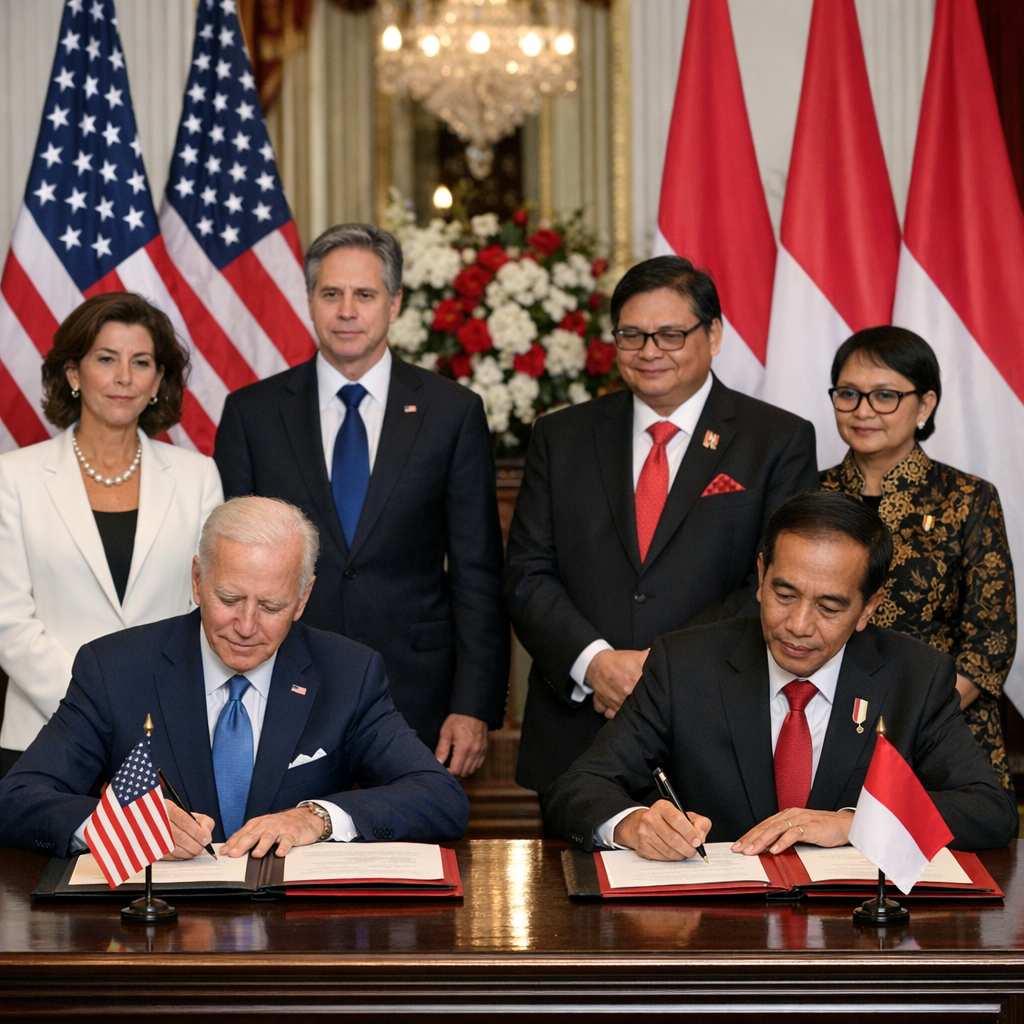
The relationship between the United States and Indonesia has entered a new phase, marked by significant economic agreements and strategic collaborations. This development holds considerable implications for Indonesia’s economy and its position on the global stage.
Recent Trade Agreements
In February 2026, the United States and Indonesia signed the Agreement on Reciprocal Trade (ART), setting U.S. tariffs on Indonesian products at 19%. This agreement also includes Indonesia’s commitment to invest $33 billion in key U.S. sectors such as agriculture, aerospace, and energy. Notably, Indonesia will purchase U.S. resources like coal, petroleum, gas, aircraft, meat, and soybeans. Additionally, the pact promotes cooperation in critical minerals and rare earths, leveraging Indonesia’s substantial nickel reserves and newly identified rare earth deposits.
Strategic Implications
These agreements signify a deepening of the U.S.-Indonesia partnership, extending beyond economic ties to encompass strategic collaboration. The focus on critical minerals and rare earths is particularly noteworthy, as it positions Indonesia as a key player in the global supply chain for these essential resources. This partnership also reflects a shared commitment to regional stability and security, with both nations recognizing the importance of maintaining peace and stability in the Indo-Pacific region.
Challenges and Considerations
While the agreements offer substantial opportunities, they also present challenges. Analysts have pointed out potential hurdles in implementing the trade deal, including the need for Indonesia to adjust certain national policies to comply with the agreement’s terms. Additionally, the evolving global trade landscape, influenced by factors such as the U.S. Supreme Court’s decisions on tariff policies, adds a layer of complexity to the bilateral relationship.
Conclusion
The strengthening of U.S.-Indonesia relations through recent trade agreements marks a significant milestone in the bilateral partnership. As both nations navigate the complexities of these agreements, the focus remains on fostering mutual economic growth and contributing to regional stability. For Indonesia, this partnership offers a pathway to enhance its economic development and assert its strategic importance in the global arena.